March 15, 2026
Each Sunday from 4:00 to 5:00 p.m., Sarasota United for Responsibility and Equity (SURE) holds a prayer vigil at Payne Park in Sarasota — a companion vigil to one held simultaneously at the Big Cypress detention facility in the Everglades by the Miccosukee Tribe. This article captures my personal reflection from an in-person visit to the vigil in Big Cypress.
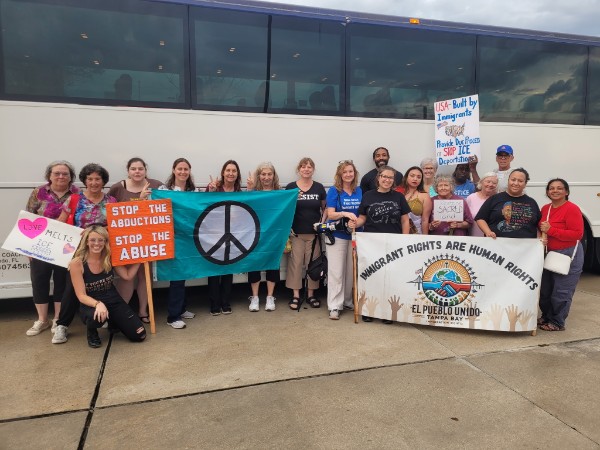
On Sunday, March 15, I joined a group of interfaith and interagency community organizers on a charter bus to the South Florida Detention Facility — more commonly known as “Alligator Alcatraz” — located within Big Cypress National Preserve in Ochopee, Florida.
Those in attendance shared a common purpose: to stand in solidarity with the Miccosukee Tribe of Indians, who have lived in and cared for the land now known as the Big Cypress National Preserve since time immemorial. I want to clarify up front that we were not there to protest or demonstrate any political ideology. We were there for a prayer vigil centering peace and dignity for the land and people. When Big Cypress National Preserve was established by law in 1974, the Miccosukee, Seminole, and Traditional people were provided with permanent rights to occupy and use the land in traditional ways; in addition, they have first rights to develop income-producing businesses related to the resources and use of the preserve, such as guided tours. The detention center’s proximity to the tribe’s villages, sacred and ceremonial sites, traditional hunting grounds, and other lands protected by the tribe raises significant concerns about environmental degradation. I attended to personally observe and record the detention facility’s environmental and human rights impact.
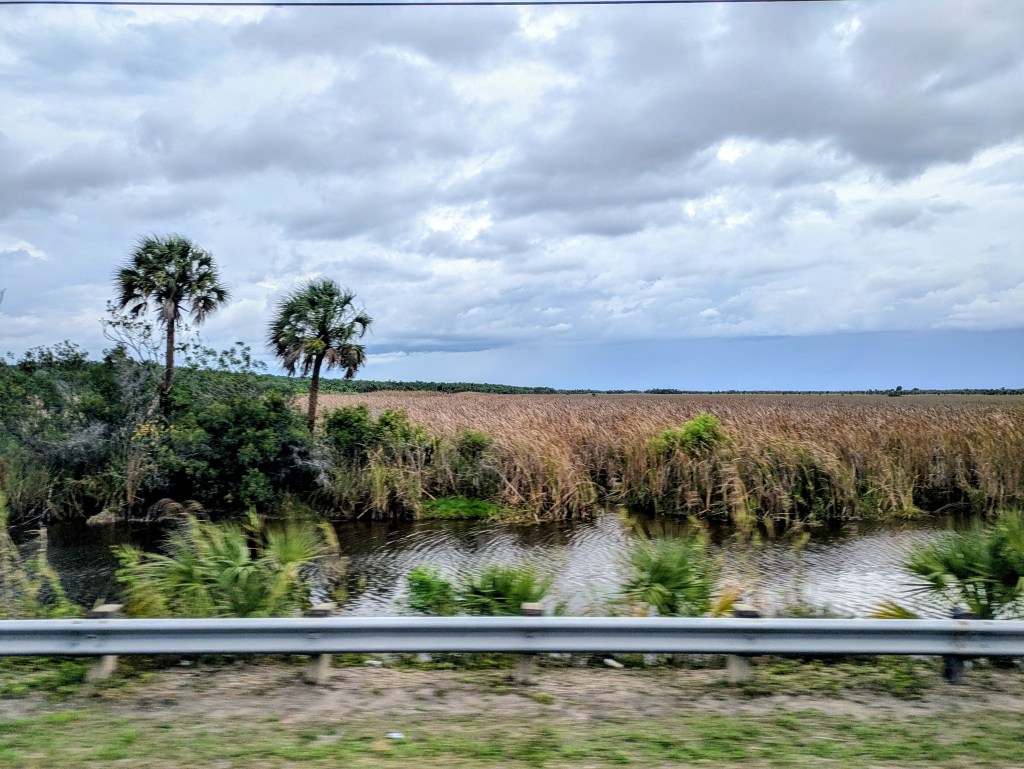
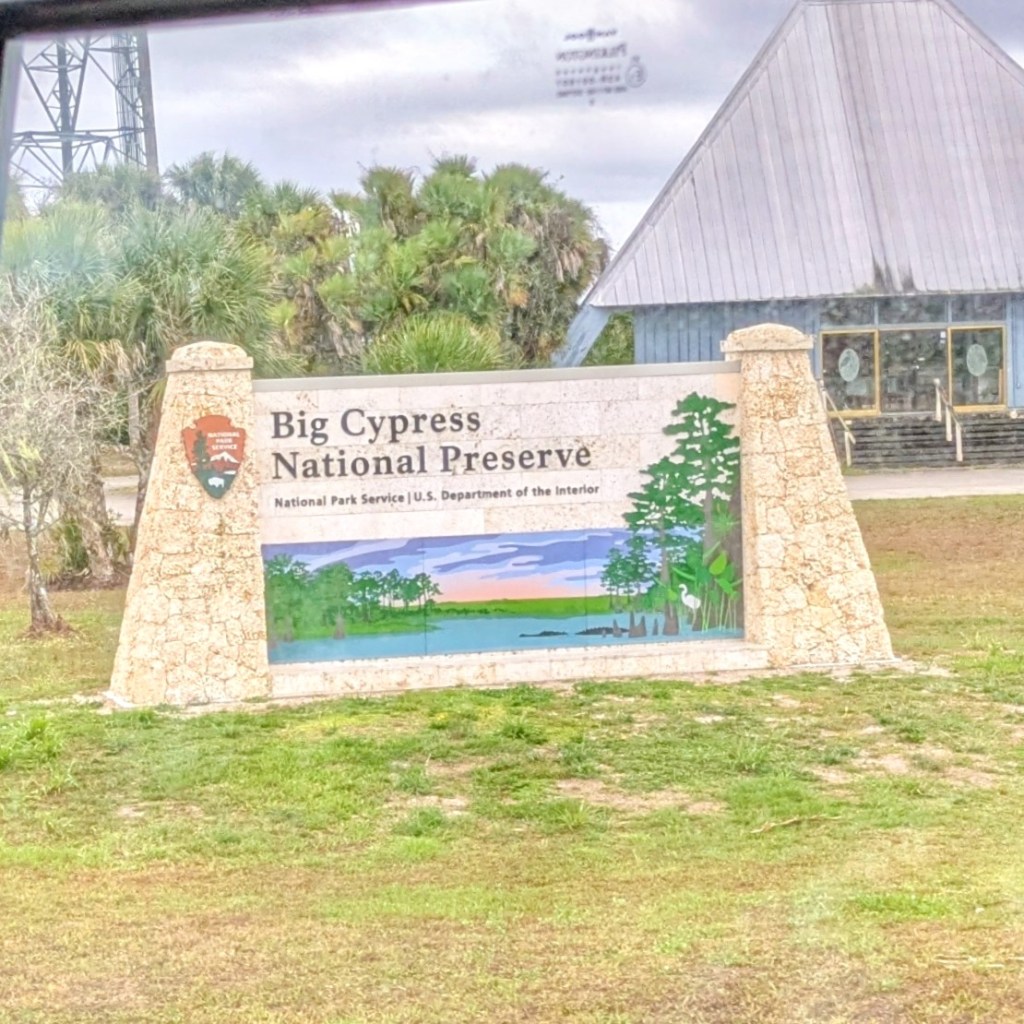
Our group departed from Sarasota, heading south on I-75. After a short bathroom break in Naples, we continued east on Tamiami Trail, traveling from coastal marshlands into prairies and pinelands. A friend noted this shift, commenting on the eeriness of the Everglades, while literal storm clouds rolled across the horizon. At a stop, I snapped a photo of the entrance sign to Big Cypress National Preserve and was reminded of a quote by pioneering environmentalist Marjory Stoneman Douglas. She said, “There are no other Everglades in the world. They are, they have always been, one of the unique regions of the earth; remote, never wholly known. Nothing anywhere else is like them.”
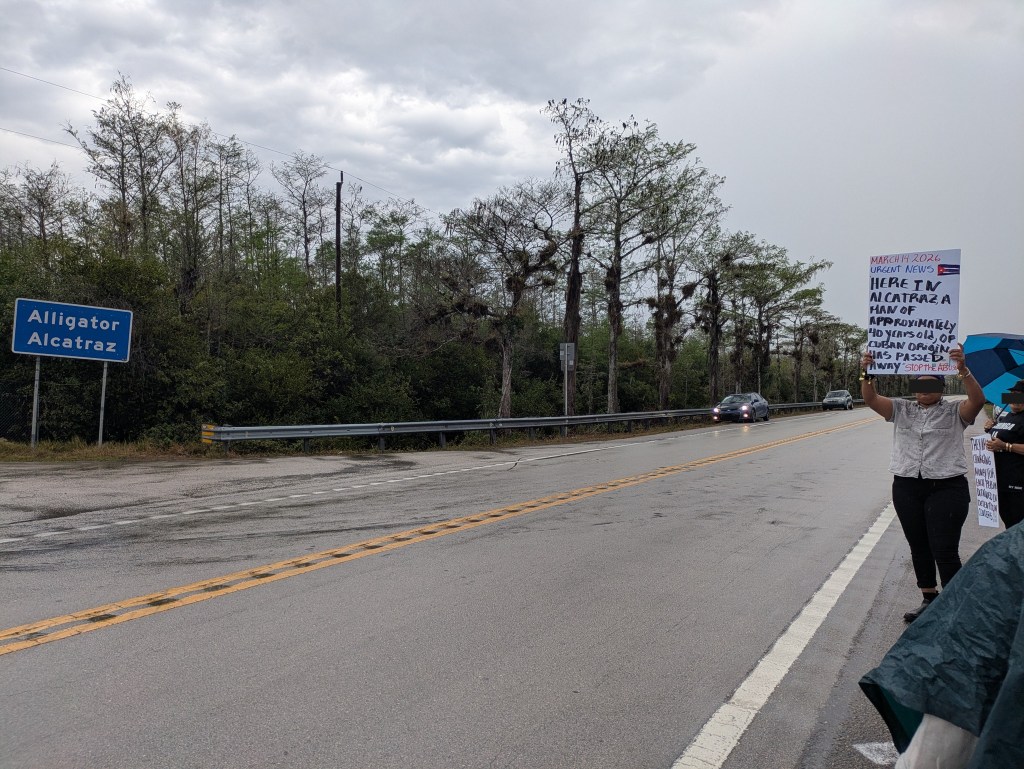
We arrived a few minutes late to the vigil, where buses and cars of people from cities across the state, including Coral Gables, Fort Myers, Miami, and Naples, were already present. We joined them under two canopies in the pouring rain. An indigenous elder opened with a call to prayer and song. Leaders and laity from Christian, Jewish, Buddhist, and other faiths offered prayers and words of solidarity. Due to a swift-moving storm front and potential for lightning, we were encouraged to stay on the buses. Several people chose to stand on the side of the road in front of the detention center, holding signs and praying.
I had the chance to speak with several people who had traveled from across the state. I heard the story of a lawyer who stated that when she visits her client, she drives down the entry road to a parking lot, and from there, she is escorted in a blacked-out van to a meeting area; she’s never been allowed inside the main detention facility. There are people with loved ones inside who shared that their family members were not being well-fed and they were being denied medication, including life-saving insulin and heart medicine. Once again, I am reminded of Marjory Stoneman Douglas’s words: “remote, never wholly known.” The detention facility is not visible from Tamiami Trail, the two-lane highway that passes by, and the only indication of its existence are police vehicles and signs marking the entry road.
I noticed, standing on the side of the road, how quiet the natural world was. The Everglades should have been alive with frogs calling in the rain, cicadas, the hum and buzz of ten thousand other unseen creatures going about their lives. Instead, there was the rumble of bus engines and the occasional honk of passing cars. The only wildlife I saw were turkey vultures circling overhead, a few snowy egrets standing at the water’s edge, and mosquitoes — proof that something small and stubborn was still out there, holding on.
On our ride home, I couldn’t help but feel a sense of hope as purple lightning crackled over freshwater marl prairies, a cold spring rain quenching the drought-parched earth. While some might have said the storm was portentous, I felt a sense of relief. Rain is calming, rain is purifying. With it, wetlands can flow clean water across the Greater Everglades ecosystem and into the vital estuaries along Florida’s southwest coast. In fact, the massive, buttressed trunks of the bald cypress trees, for which the park was named, develop in response to growing in soft, wet soil, serving as living bridges between heaven and earth, thriving in water while reaching for the sky.
In February, I attended a foraging event with Robin Greenfield at the Orange Blossom Community Garden. While there, I was given some locally foraged black sapote fruit, which I took home, baked into brownies, and shared with my neighbors. I saved the seeds in a little bag until today, when I tucked them into the front pocket of my backpack on the way out the door. Maybe it was the spirit of the mighty skunk ape moving through me — the Everglades’ own legendary Bigfoot — but something in me knew that someone at this vigil would want these seeds. Mutual aid, education, and community are part of the reason our species has managed to survive for this long. Sure enough, I had the pleasure of meeting a man affiliated with a farm and community-organizing space in Southwest Miami-Dade County. He offered me a photo magnet of two herons, and in exchange, I gave him the seeds.
There is a concept that Zen Buddhist teacher Thich Nhat Hanh calls interbeing — the idea that nothing exists in isolation, that we are made of and sustained by everything around us. I felt it in that seed exchange. I felt it in the rain. I felt it in the sacredness of our prayers and collective action under that canopy. As I carry this day into the week ahead, a question lingers in my soul: What does it mean to hold a space as sacred? I don’t think it means keeping it untouched or unseen. I think it means bearing witness. To me, it means knowing the names of the grasses, the tribes, the seeds, the birds, and the people detained behind fences I cannot see from the road. It means returning, again and again, with open hands — the way rain returns to the Everglades, the way seeds find their way back into the earth, the way we find the light in each other, and hold it high.
 Andrea N. Buscemi